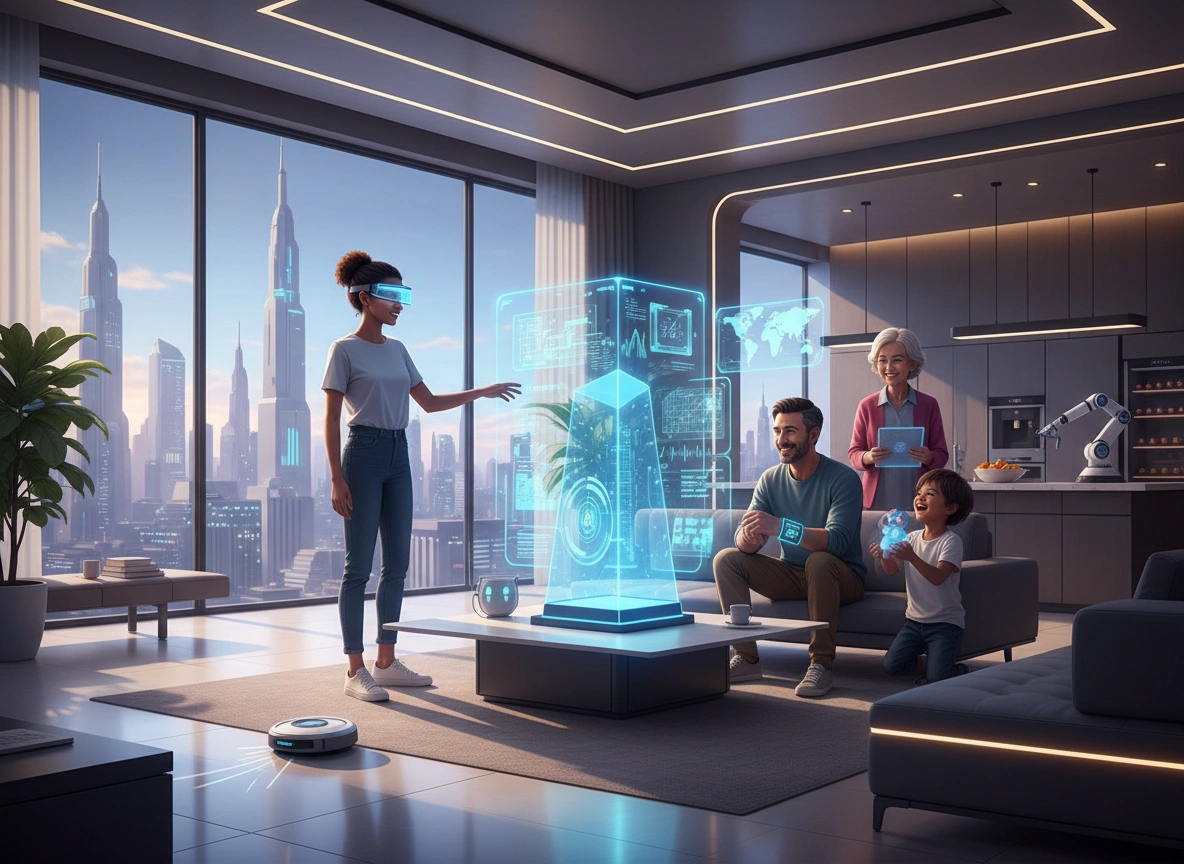
Artificial intelligence is steadily moving from the realm of science fiction into the fabric of our daily routines. While we may not have sentient robots as companions just yet, AI is already powering the recommendation engines we use for shopping, the navigation apps that guide our commutes, and the virtual assistants that answer our questions. The true transformation, however, is just beginning. As AI technology continues to mature, its integration into everyday life will become deeper and more profound, reshaping our world in ways we are only starting to imagine.
This evolution will bring about unprecedented convenience and efficiency, but it also presents new challenges that we must navigate carefully. From our health and education to how we travel and entertain ourselves, AI is poised to redefine what is possible. Understanding this future is key to preparing for it, allowing us to harness its potential while mitigating its risks.
AI’s Revolutionary Impact on Healthcare
The healthcare industry is on the cusp of a major transformation, with AI promising to make services more personalized, predictive, and accessible. The technology’s ability to analyze vast datasets far exceeds human capability, leading to breakthroughs in diagnostics, treatment, and ongoing patient care.
Predictive Diagnostics and Personalized Medicine
One of the most significant contributions of AI in healthcare will be its role in early disease detection. AI algorithms can analyze medical images like X-rays, MRIs, and CT scans with remarkable accuracy, often identifying signs of diseases like cancer or diabetic retinopathy before they would be noticeable to the human eye. This early detection dramatically improves patient outcomes and reduces treatment costs.
Beyond diagnostics, AI is paving the way for hyper-personalized treatment plans. By analyzing a patient’s genetic information, lifestyle, and medical history, AI systems can help doctors predict which treatments will be most effective for an individual. This moves medicine away from a one-size-fits-all approach and toward precision care tailored to each person’s unique biological makeup.
Virtual Health Assistants and Accessibility
Access to medical advice is another area where AI will make a substantial difference. AI-powered virtual health assistants and chatbots can provide 24/7 support for patients, answering questions, monitoring symptoms, and reminding them to take medication. These tools can serve as a first point of contact, helping to triage cases and ensure that those with urgent needs are prioritized for human intervention. This not only improves efficiency but also makes healthcare more accessible for people in remote areas or with mobility issues.
Reimagining Education for the Digital Age
Education is another sector ripe for an AI-driven overhaul. AI tools are set to create more adaptive, engaging, and individualized learning experiences, catering to the unique pace and style of each student.
Personalized Learning Paths
Traditional classrooms often struggle to accommodate the diverse learning needs of every student. AI can solve this by creating personalized learning paths. Adaptive learning platforms use AI to assess a student’s performance in real-time and adjust the curriculum accordingly. If a student is struggling with a concept, the system can provide additional resources and exercises. If they are excelling, it can introduce more advanced topics to keep them engaged.
This tailored approach helps ensure that no student is left behind or held back. It empowers learners to take control of their education, focusing on areas where they need the most support and moving quickly through material they have already mastered.
The Changing Role of the Educator
With AI handling routine tasks like grading, lesson planning, and administrative work, teachers will have more time to focus on what they do best: mentoring, inspiring, and providing one-on-one support to students. AI will not replace educators but will instead augment their capabilities, transforming them into facilitators of learning. This human-AI collaboration will foster a more dynamic and supportive educational environment, nurturing critical thinking, creativity, and problem-solving skills that are essential for the future.
The Autonomous Revolution in Transportation
The way we move from one place to another is set for its most significant disruption since the invention of the automobile. AI is the engine driving the development of autonomous vehicles (AVs), which promise to make our roads safer, less congested, and more efficient.
The Promise of Self-Driving Cars
Autonomous vehicles have the potential to drastically reduce traffic accidents, the vast majority of which are caused by human error. Equipped with a sophisticated array of sensors, cameras, and AI algorithms, self-driving cars can perceive their environment and make decisions with superhuman speed and precision.
Beyond safety, AVs will redefine our relationship with travel. Commute times can become productive or relaxing, as passengers are free to work, read, or watch a movie. This technology will also greatly enhance mobility for the elderly and people with disabilities, granting them a new level of independence.
Smart Traffic Management
AI’s impact on transportation extends beyond individual vehicles. AI-powered traffic management systems can analyze real-time data from vehicles, road sensors, and public transit to optimize traffic flow. These systems can dynamically adjust traffic light timings, reroute vehicles to avoid congestion, and predict traffic patterns to prevent bottlenecks before they occur. The result will be smoother journeys, reduced travel times, and a smaller carbon footprint for our cities.
The Truly Smart Home
While many of us already have smart speakers or thermostats, the future of home automation is far more integrated and intuitive. An AI-powered smart home will anticipate your needs and manage your living space with seamless efficiency.
Imagine a home that knows your daily routine. It wakes you up with gradually increasing light, starts the coffee maker, and sets the thermostat to your preferred temperature. It can manage your grocery list by tracking what you use and automatically placing an order when you run low. AI will also enhance home security, using facial recognition to grant access to family members while alerting you to any unusual activity. This level of automation will free up valuable time, allowing you to focus on more meaningful activities.
Entertainment Tailored to You
AI is already a dominant force in entertainment, with streaming services using sophisticated algorithms to recommend movies and music. In the future, this personalization will become even more granular and immersive.
AI will not only suggest content but may also have a hand in creating it. AI-generated music, art, and even simple storylines are already a reality. In gaming, AI will create non-player characters (NPCs) that are more dynamic and realistic, responding to players’ actions in unscripted and intelligent ways. This will lead to more engaging and endlessly replayable experiences. Virtual and augmented reality, powered by AI, will offer immersive entertainment that blurs the line between the digital and physical worlds.
Navigating the Challenges Ahead
The transition to an AI-integrated society is not without its challenges. Concerns about job displacement are valid, as AI and automation are likely to take over many routine and repetitive tasks. Preparing for this shift requires a focus on reskilling and upskilling the workforce, emphasizing roles that require creativity, critical thinking, and emotional intelligence.
Data privacy is another major hurdle. The AI systems that will power our future rely on vast amounts of personal data. Establishing robust regulations and ethical guidelines for how this data is collected, stored, and used is critical to building trust and protecting individuals. Furthermore, algorithmic bias is a significant risk. If AI systems are trained on biased data, they can perpetuate and even amplify existing social inequalities. Ensuring fairness and transparency in AI development is essential to creating an equitable future.
The future of AI in everyday life is one of immense possibility. From revolutionizing healthcare to making our cities smarter and our homes more intuitive, AI has the potential to solve some of our biggest challenges and enhance our quality of life in countless ways. By embracing this technology thoughtfully and addressing its challenges proactively, we can shape a future where human and artificial intelligence work together to create a better world for everyone.
Please visit website for more info